
The Butlerian Bifurcation: Dune as a Dynamical System of Cognitive Delegation. Part II
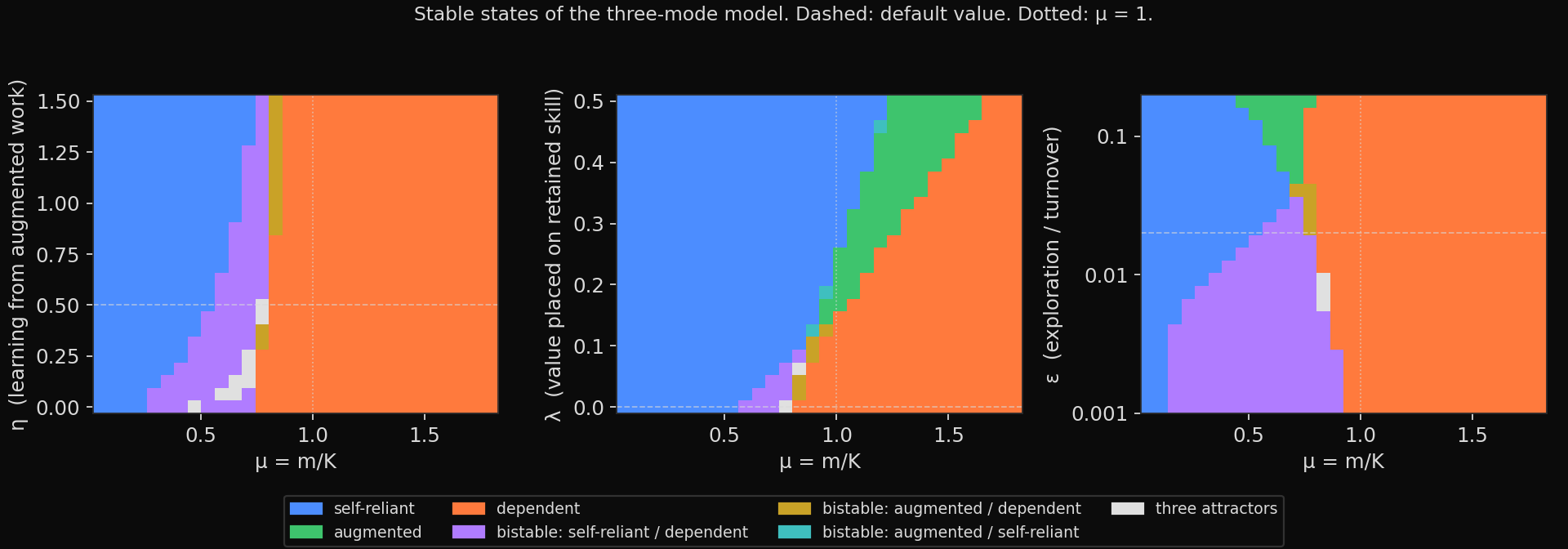
Part I modeled cognitive delegation with two variables and found a threshold: once machines reach the human ceiling, self-reliance disappears and full dependency is the only attractor. Three of that model's assumptions did the work. This part drops them: populations can relearn from nothing, delegation can be abandoned, and AI-assisted work can teach. The threshold survives, but it splits into two, and the gap between them is hysteresis. Dependency becomes escapable at a price set by how rigid the population is. And a stable mixed state, human and machine together, appears once the population places a value on the skill it keeps.
Introduction
The model in Part I had two state variables, skill h and delegated share d, and one conclusion that mattered: the dependency attractor is stable at every level of machine capability, and the self-reliant attractor vanishes through a transcritical bifurcation at μ = 1, where μ is machine capability relative to the human ceiling K. Its Discussion named the assumptions that produced this. Skill grew in proportion to existing skill, so h = 0 was absorbing. Delegation receded only when humans outperformed machines, so d = 1 had no exit. And every use of a machine counted as lost practice, so no mixed state could hold.
This part replaces those three assumptions with parameters and asks what happens to the phase portrait. The model has one more state variable and eight parameters instead of four, and it is still small enough to map.
The Model
Work in a task domain is done in one of three modes: unaided, augmented (human and machine on the same task), or delegated (machine alone). Their shares sH, sA, sD sum to one. Skill h ∈ [0, 1] follows
dh/dt = ℓ(1 − h) + (s_H + η s_A)(1 − h) − (δ + β s_D) h
Time is measured in units of the unaided learning rate, and K = 1. The new terms: ℓ is baseline learning that does not depend on practice (education, cohort replacement, retraining); η is how well augmented work teaches, relative to unaided work; δ is ordinary forgetting; β is delegation-specific atrophy, the b of Part I.
Each mode has an output and a payoff. Unaided output is h; delegated output is m; augmented output is 1 − (1 − h)(1 − m), the probability that at least one of two independent attempts succeeds. Augmentation carries a verification cost τA. A population may also value the skill a mode leaves behind, at weight λ:
π_H = h + λ(1 − h)
π_A = 1 − (1 − h)(1 − m) − τ_A + λ η (1 − h)
π_D = m − λ β h
Shares follow a replicator rule with exploration (Hofbauer & Sigmund, 1998): each share grows in proportion to its payoff advantage over the population mean, and a term ε(1/3 − sj) pulls every share toward uniform at rate ε. ε stands for turnover, experimentation, and policy churn, and it is what makes sD = 1 and sD = 0 non-absorbing.
With ℓ = ε = λ = 0 and the augmented mode removed, the model reduces to Part I with the practice term (1 − h) in place of h(1 − h). Every result below is therefore a statement about what the three dropped assumptions were hiding. Unless stated otherwise the figures use ℓ = 0.05, δ = 0.05, β = 1, η = 0.5, τA = 0.1, ε = 0.02, λ = 0.
Where the Corners Went
Two closed forms locate the states that were corners in Part I. If all work is delegated, skill settles at h = ℓ/(ℓ + δ + β) = 0.045 rather than 0. If all work is unaided, it settles at h = (1 + ℓ)/(1 + ℓ + δ) = 0.955 rather than 1. Exploration keeps the shares mixed, so the computed states sit a little inside these: the self-reliant node has h ≈ 0.94 at small μ, and the dependent node has h between 0.12 (at μ = 0.55) and 0.07 (at μ = 1.8).
Two inequalities decide the mode contest at λ = 0. Augmentation beats unaided work when m(1 − h) > τA: the machine must add enough to what the human lacks to pay for verification. Augmentation beats delegation when h(1 − m) > τA: the human must add enough to what the machine lacks. The second condition fails as m → 1, which is why augmentation cannot be the end state at λ = 0, however good the machine.
Result 1: The Threshold Splits
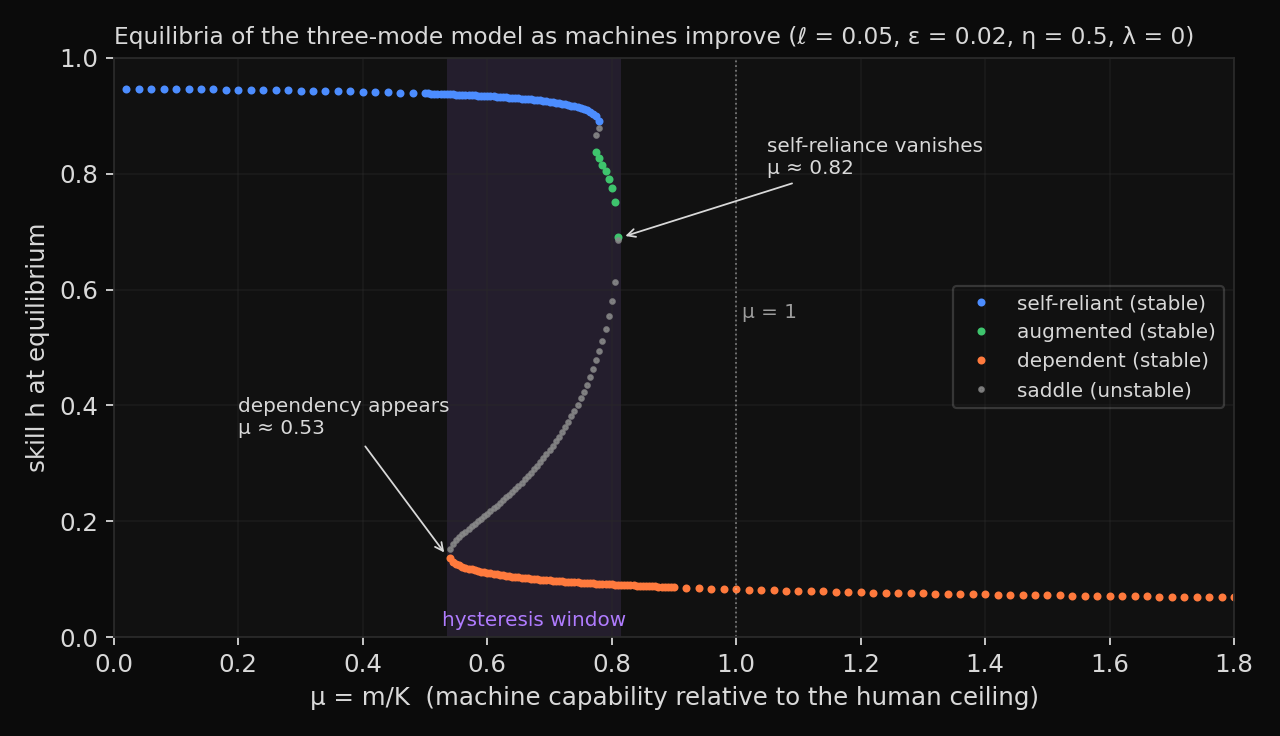
Equilibria of the three-mode model against μ, default parameters. Stable states in colour, saddles in grey. The dependent state appears at μ ≈ 0.53; the self-reliant state hands over to a short-lived augmented node near μ ≈ 0.78 and that node vanishes at μ ≈ 0.82. Shaded: the hysteresis window.
The transcritical bifurcation of Part I is structurally unstable: any perturbation of the vector field that breaks the invariance of the corner lines unfolds it into a pair of saddle-node bifurcations (Strogatz, 2015). ℓ and ε are such perturbations. The result is a fold at μ ≈ 0.53, where the dependent state and a saddle are born together, and a fold at μ ≈ 0.82, where the self-reliant branch and the same saddle annihilate. Between the folds the system is bistable, as it was in Part I for every μ < 1. Outside them it is not: below 0.53 only self-reliance exists, above 0.82 only dependency.
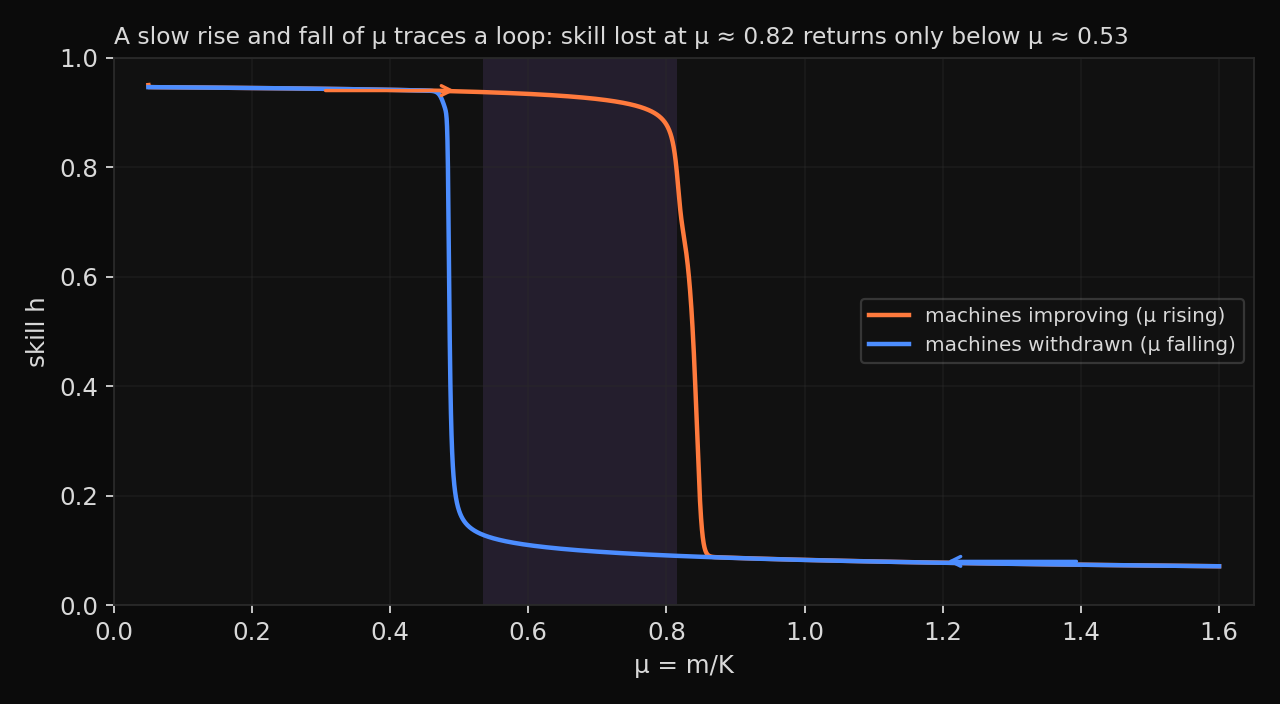
Skill along a slow ramp of μ from 0.05 to 1.6 and back. The ramp lags the folds by a few hundredths: skill collapses near μ ≈ 0.84 on the way up and recovers near μ ≈ 0.49 on the way down.
Bistability between two folds is hysteresis. A population that enters dependency at the upper fold is not returned to self-reliance by lowering μ back below it; the dependent state remains stable down to the lower fold, and only there does the population relearn. The distance between the folds is the price of re-entry, and Part I could not compute it because its dependent state was absorbing.
The upper fold sits below μ = 1. The self-reliant node has h ≈ 0.94, not K, because forgetting and exploration keep it off the ceiling, and delegation begins to pay once m exceeds the population's realized skill rather than its ceiling. Part I's threshold at exactly μ = 1 was an artefact of a population that sat exactly at K.
Result 2: The Width of the Window Is Set by Turnover
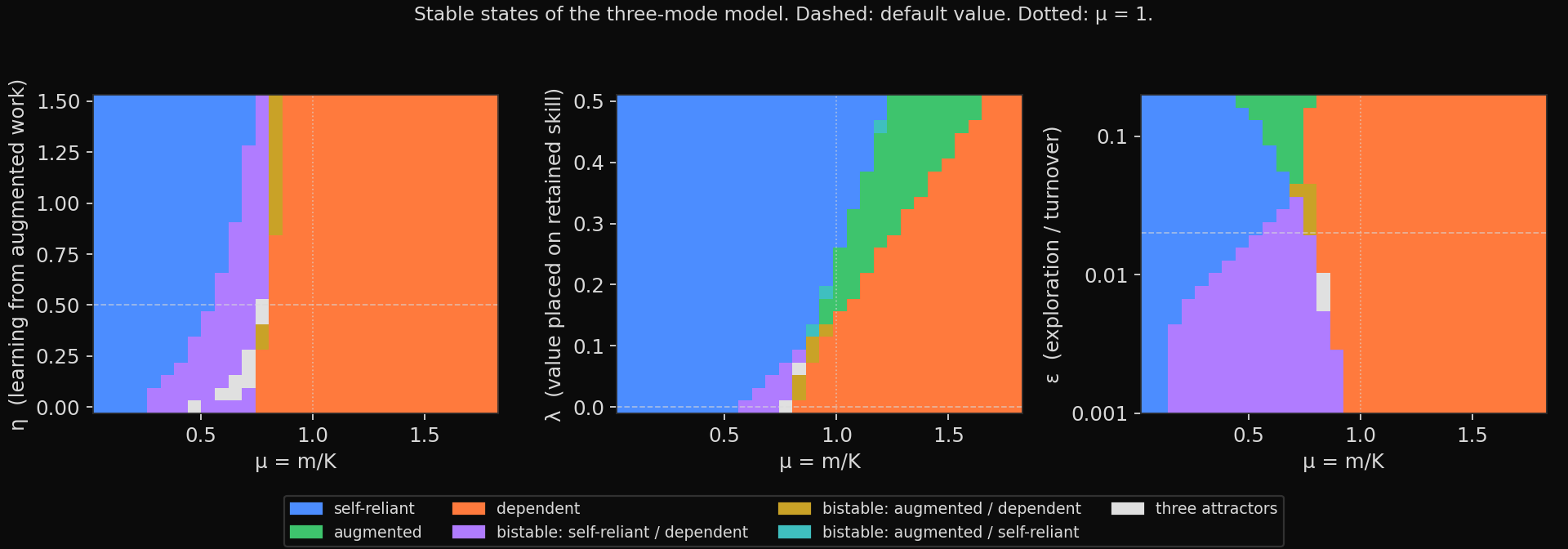
Stable states in three parameter planes. Left: μ against η. Centre: μ against λ. Right: μ against ε on a log scale. Blue: self-reliant only. Green: augmented only. Orange: dependent only. Purple: bistable, self-reliant and dependent. Gold and teal: the other bistable pairs. Dashed: the default value; dotted: μ = 1.
The right panel shows the hysteresis window as a function of ε. At ε = 0.001 the window runs from roughly μ = 0.15 to 0.9: a population that rarely changes its practice enters dependency near the ceiling and leaves it only when machines have fallen to a fraction of human ability. At ε = 0.02, the default, the window is [0.53, 0.82]. At ε ≈ 0.08 the folds merge and the window closes; the transition is then a smooth crossover near μ ≈ 0.75 with no memory. Populations with high turnover also pass through a stable augmented regime on the way, visible in green at the top right, because exploration keeps enough unaided work alive to make the augmented mode's h(1 − m) advantage worth its cost.
Table 1 gives the window at five values of ε.
Result 3: The Centaur Exists When Skill Is Priced
The centre panel is the main new result. At λ = 0 the augmented state is a transient: a narrow green band near μ ≈ 0.8, between the self-reliant and dependent regimes. At λ ≥ 0.17 the band opens into a regime. A population that weights the skill a mode leaves behind at a fifth of the value of output holds a stable augmented state, with h between 0.5 and 0.9, across the whole interval where Part I predicted collapse, and the dependent state takes over only at μ ≈ 1.1. At λ = 0.5 that boundary is at μ ≈ 1.7. The hysteresis window closes at the same λ: a population that prices skill enters and leaves states reversibly.
η matters less than λ. Raising η from 0 (augmented work teaches nothing) to 1.5 (it teaches better than unaided work) moves the collapse from μ ≈ 0.77 to μ ≈ 0.89 and shifts the lower fold from 0.29 to 0.77, narrowing the window without opening an augmented regime. Whether AI-assisted work teaches decides how much skill the population keeps while it uses machines; whether the population values that skill decides whether it keeps using them that way.
Part I's delegation cap dmax reappears here as λ. There it was a rule imposed on the population; here it is a term in the payoff, a preference the population acts on. The two are not equivalent, since a cap binds regardless of payoff and λ can be outbid by a large enough m, but they play the same role: both keep the mixed state from sliding to the corner.
Dune, Reread
The Great Revolt destroyed the machines and then held μ near zero for ten thousand years. Part I read this as a reset of state. Part II reads it as a forced traverse of the hysteresis loop. A population in the dependent state cannot be freed by making the machines slightly worse; it must be carried below the lower fold, and for a rigid society with small ε that fold lies near μ = 0.15. The Revolt's destruction was not excess; it was the width of the window. The taboo that followed is a policy on ε: it held the population's practice fixed and so kept the window wide, which protected against re-entry and also made re-entry, if it happened, permanent.
The Mentat schools raise K and so lower μ; that reading stands. The spice economy changes the supplier of m, which this model still cannot represent. The Golden Path is unchanged from the revision of Part I: decoupling protects populations still below their own upper fold from importing the delegation habits of those above it, and does nothing for a population already past it.
The Imperium never priced skill. Its institutions valued output, and where they valued a human capability (Mentats, Navigators) they made it a caste, which is a cap, not a λ. The model's stable centaur, an augmented state that persists past the ceiling because the population wants to keep what it knows, has no counterpart in the novels.
Reading 2026 Through the Model
Part I pointed to three quantities: the atrophy rate, the delegation cap, and the coupling between populations. Part II replaces the first two with three that can be measured.
η, whether AI-assisted work teaches. This is the parameter the deskilling debate is about, and the model does not fix its sign. A randomized comparison of unaided, augmented, and delegated conditions on the same task distribution, with delayed AI-free testing, measures it directly. Budzyń et al. (2025) measured something close to β, the atrophy under delegation, in colonoscopy; η has not been measured in any domain I know of.
ε, how fast practice changes. It sets the width of the hysteresis window and therefore the cost of any future retreat from delegation. Professions with slow turnover and fixed procedure have small ε and wide windows; they enter dependency late and leave it only under extreme reversal.
λ, the price a community places on retained skill. The declaration by Fields Medalists in September 2026 (Avila et al., 2026) is, in this model's terms, a statement that λ > 0 for research mathematics: the signatories say that solved problems are a proxy and that understanding, which lives in people, is the goal. If the community acts on that, the model predicts an augmented regime that survives μ > 1. If it does not, the model predicts the transient of the λ = 0 panel: a brief period of augmentation, then collapse.
Discussion and Limitations
The model is a toy with defaults chosen for legibility, not fitted values. The fold positions, the width of the window, and the λ at which the augmented regime opens all depend on δ, β, and τA, which are held fixed here, and on the functional forms: the augmented output 1 − (1 − h)(1 − m) assumes independence of the two attempts, and the uniform exploration target treats all three modes as equally likely under churn. Regime labels come from the dominant share at each attractor, computed by forward integration from six starts, so an attractor with a very small basin could be missed. The ramp in the second figure lags the folds by a few hundredths of μ because it is not infinitely slow.
Three of the gaps in Part I remain. There is no supplier, so ownership and access shocks are outside the model. There is a single population and a single task domain, so the Golden Path is still a verbal argument. And β > 0 is assumed: the model allows AI-assisted work to teach but still treats delegated work as atrophy.
The reviewer's argument that dropped this model's assumptions predicted that the exact bifurcation would disappear and the model would become less elegant and more credible. The first half is right, the threshold is now two folds with a memory between them. On the second half the model is more legible than expected: each of the three new mechanisms controls one feature of the phase portrait, and the features can be named.
Conclusion
Relaxing three assumptions of Part I changes the phase portrait in three specific ways. The transcritical threshold at μ = 1 unfolds into two saddle-node bifurcations at μ ≈ 0.53 and μ ≈ 0.82, and the interval between them is hysteresis: dependency, once entered, is left only when machines fall well below the level at which it was entered. The width of that interval is set by ε, the rate at which practice changes, and a rigid population pays the Great Revolt's price to escape. And a stable mixed state exists once the population prices retained skill, λ ≥ 0.17 at the defaults; without that, augmentation is a transient on the way down.
The quantity Part I could not name is now the one that matters. Machine capability sets the deadline, atrophy sets the speed, and the value a population places on its own skill decides whether the mixed state holds. That value is not a property of the machines and cannot be set by their suppliers. It is set by the population, and in 2026 the first research community to say so in writing was mathematics.
References
Avila, A., Bhargava, M., Birkar, C., et al. (2026). A Severe Misalignment of AI in Mathematics. Declaration, 11 September 2026. https://doi.org/10.5281/zenodo.22737750
Blattner, M. (2026). The Butlerian Bifurcation: Dune as a Dynamical System of Cognitive Delegation. tangential.ch
Budzyń, K., Romańczyk, M., Kitala, D., et al. (2025). Endoscopist deskilling risk after exposure to artificial intelligence in colonoscopy: a multicentre, observational study. The Lancet Gastroenterology & Hepatology, 10(10), 896–903. https://doi.org/10.1016/S2468-1253(25)00133-5
Herbert, F. (1965). Dune. Chilton Books.
Hofbauer, J., & Sigmund, K. (1998). Evolutionary Games and Population Dynamics. Cambridge University Press.
Strogatz, S. H. (2015). Nonlinear Dynamics and Chaos (2nd ed.). Westview Press.