
The Butlerian Bifurcation: Dune as a Dynamical System of Cognitive Delegation. Part I
Introduction
Frank Herbert built the Dune universe on a prohibition: "Thou shalt not make a machine in the likeness of a human mind" (Herbert, 1965). The backstory he gives for it is short. Humans delegated their thinking to machines expecting freedom, and other humans who controlled the machines enslaved them. The threat in the original novels is a dependency trap with an owner; the machines never rebel. The revolt's canonical name, the Butlerian Jihad, echoes Samuel Butler, who argued in 1863 that machines evolve and called for their destruction (Butler, 1863).
Herbert wrote the trap as history. This post writes it as dynamics. The question is the same one the 2026 AI debate keeps returning to: when a population hands part of its thinking to a tool that thinks better, does it keep the skill it stopped using? The novels answer with a taboo that lasts ten thousand years. A dynamical system answers with a phase diagram, which shows every possible outcome at once and how the balance between them shifts as machines improve.
Three ideas from dynamical systems carry the argument. A fixed point is a state the population settles into and does not leave. A basin of attraction is the set of starting conditions that end at a given fixed point; its size measures how easy that outcome is to reach. A bifurcation is a value of a control parameter at which a fixed point appears, vanishes, or changes from stable to unstable. Here the control parameter is machine capability relative to the human ceiling, and the bifurcation is the moment machines reach that ceiling.
The post proceeds in four steps. It states a two-variable model of skill and delegation, solves for its fixed points, and finds the bifurcation. It measures the basin of self-reliance numerically as machines improve. It reads four strategies from the novels as control interventions on the model: the Great Revolt, the Mentat schools, the spice economy, and Leto II's Golden Path. It then places 2026 on the phase diagram and maps six positions in the current AI debate onto the model's parameters.
The Model
Consider a population with two state variables:
- h(t): human cognitive skill, with ceiling K
- d(t) ∈ [0, 1]: the fraction of cognitive work delegated to machines
Machine capability m is a control parameter. Skill grows through practice on the undelegated share of work and atrophies on the delegated share. Delegation follows a replicator rule: it spreads when machines outperform the current human level and recedes when they do not.
dh/dt = a(1 − d) h (1 − h/K) − b d h
dd/dt = k d (1 − d)(m − h)
With x = h/K and time measured in units of 1/a, the system has three dimensionless parameters:
dx/dt = (1 − d) x (1 − x) − ρ d x
dd/dt = σ d (1 − d)(μ − x)
where μ = m/K is machine capability relative to the human ceiling, ρ = b/a is the atrophy-to-learning ratio, and σ = kK/a is the diffusion ratio. μ is the bifurcation parameter; ρ and σ set the shape of the basins at each μ. The lines h = 0, d = 0 and d = 1 are invariant, so trajectories that start in the open unit square stay there, and a population with h = 0 has no source of new skill.
Fixed Points and Stability
The system has three corner states and one interior state.
- Empty state, (h, d) = (0, 0). The eigenvalues are a and km, so the state is an unstable node for every m > 0.
- Self-reliance, (h, d) = (K, 0). The Jacobian eigenvalues are −a and k(m − K), so the state is stable for μ < 1 and a saddle for μ > 1.
- Full dependency, (h, d) = (0, 1). The eigenvalues are −b and −km, so the state is stable for every m > 0. The reason is visible in the equations: on the line d = 1 the skill equation reduces to dh/dt = −bh, and at h = 0 every positive m exceeds h, so delegation has nothing to compare itself against and never recedes.
- Interior state, h = m and d* = a(1 − μ) / (a(1 − μ) + b), which exists for μ < 1. Its Jacobian has the form [[−A, −B], [−C, 0]] with A, B, C > 0. The determinant is −BC < 0, so the state is a saddle for every parameter value. At a = b = k = 1 and μ = 1/2 the eigenvalues are (−1 ± √7)/6 ≈ 0.27429 and −0.60763.
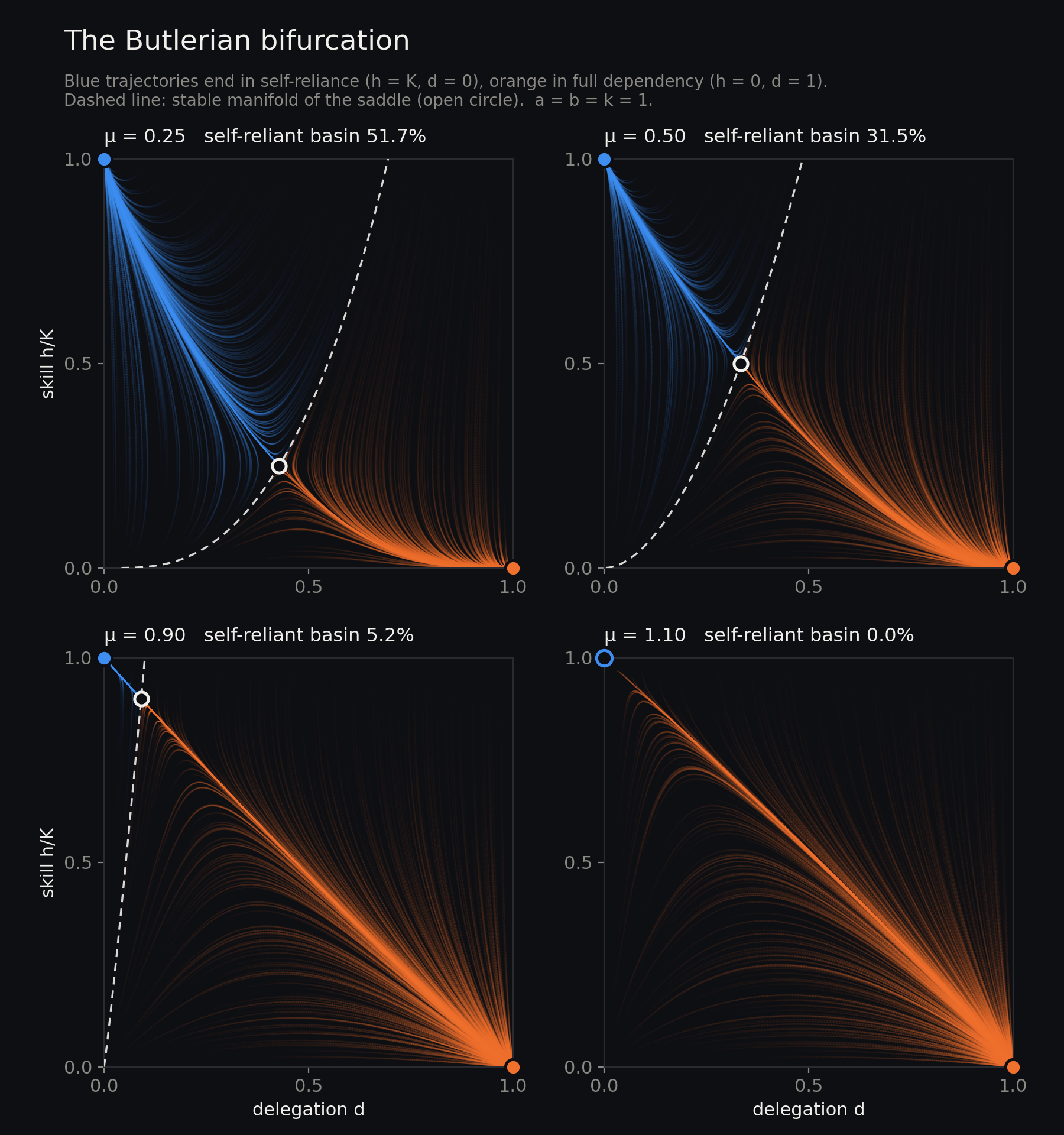
For μ < 1 the system is bistable, and the stable manifold of the saddle separates the two basins. The header figure shows both basins and the separatrix at four values of μ.
The Bifurcation at μ = 1
As μ → 1 the saddle moves to (K, 0), collides with the self-reliant node, and exchanges stability with it in a transcritical bifurcation. The exchanged branch h = m leaves the admissible square for μ > 1, so within the model the event is a boundary transcritical bifurcation. For μ > 1 and h ≤ K the factor (m − h) is positive, so d increases monotonically to 1 and h then decays at rate b. Every trajectory with d > 0 ends in full dependency.
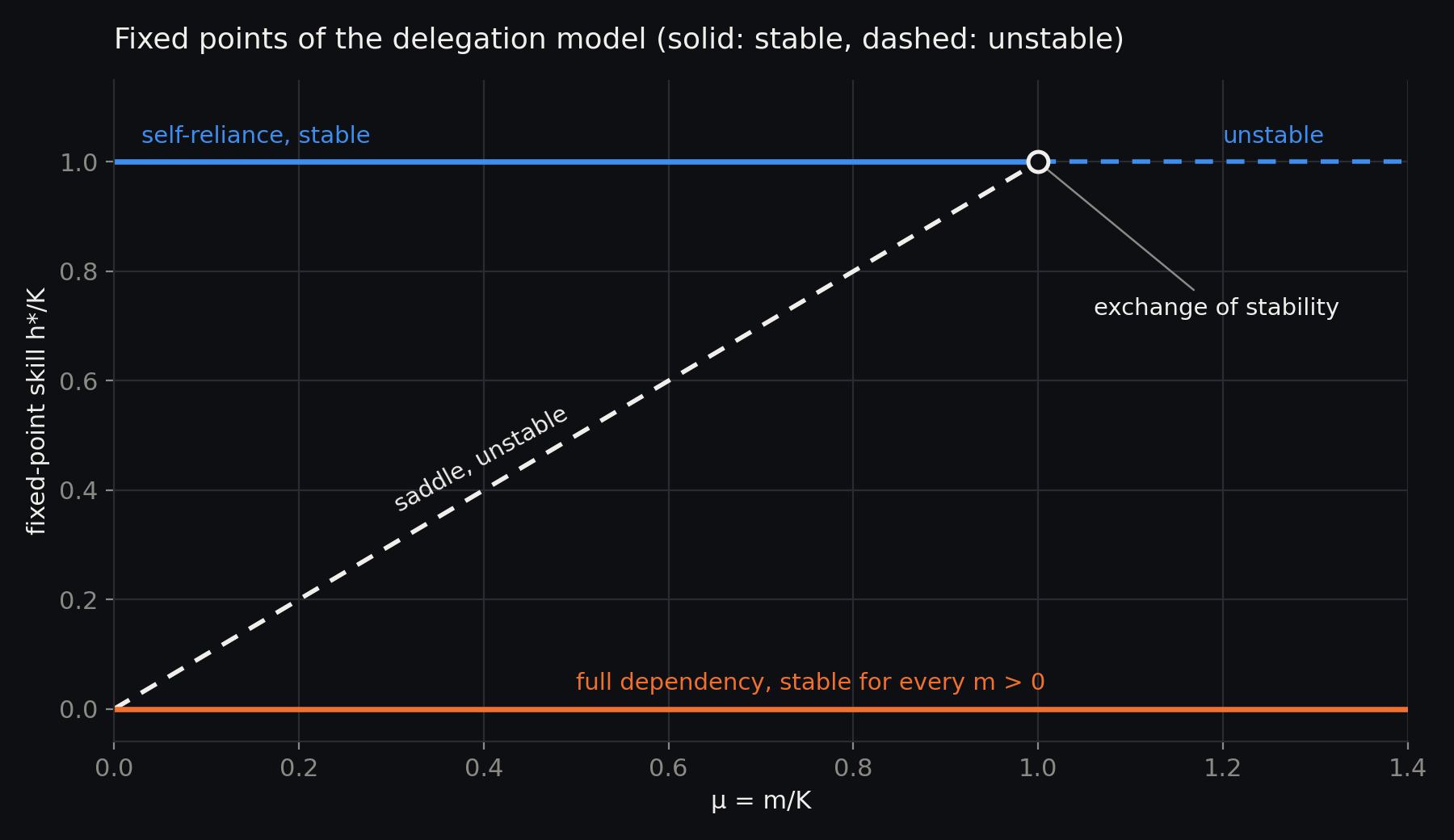
Fixed-point skill against μ. The saddle (h = m) meets the self-reliant node at μ = 1 and exchanges stability with it.
Basin Measurement
I integrated the system from a 100 × 100 grid of initial conditions on (0, K) × (0, 1) with a = b = k = 1 and K = 1 to t = 2000, and classified each endpoint within 0.01 of an attractor. All 10,000 trajectories per value of μ classified. The table lists seven values of μ; the figure below shows all 20.
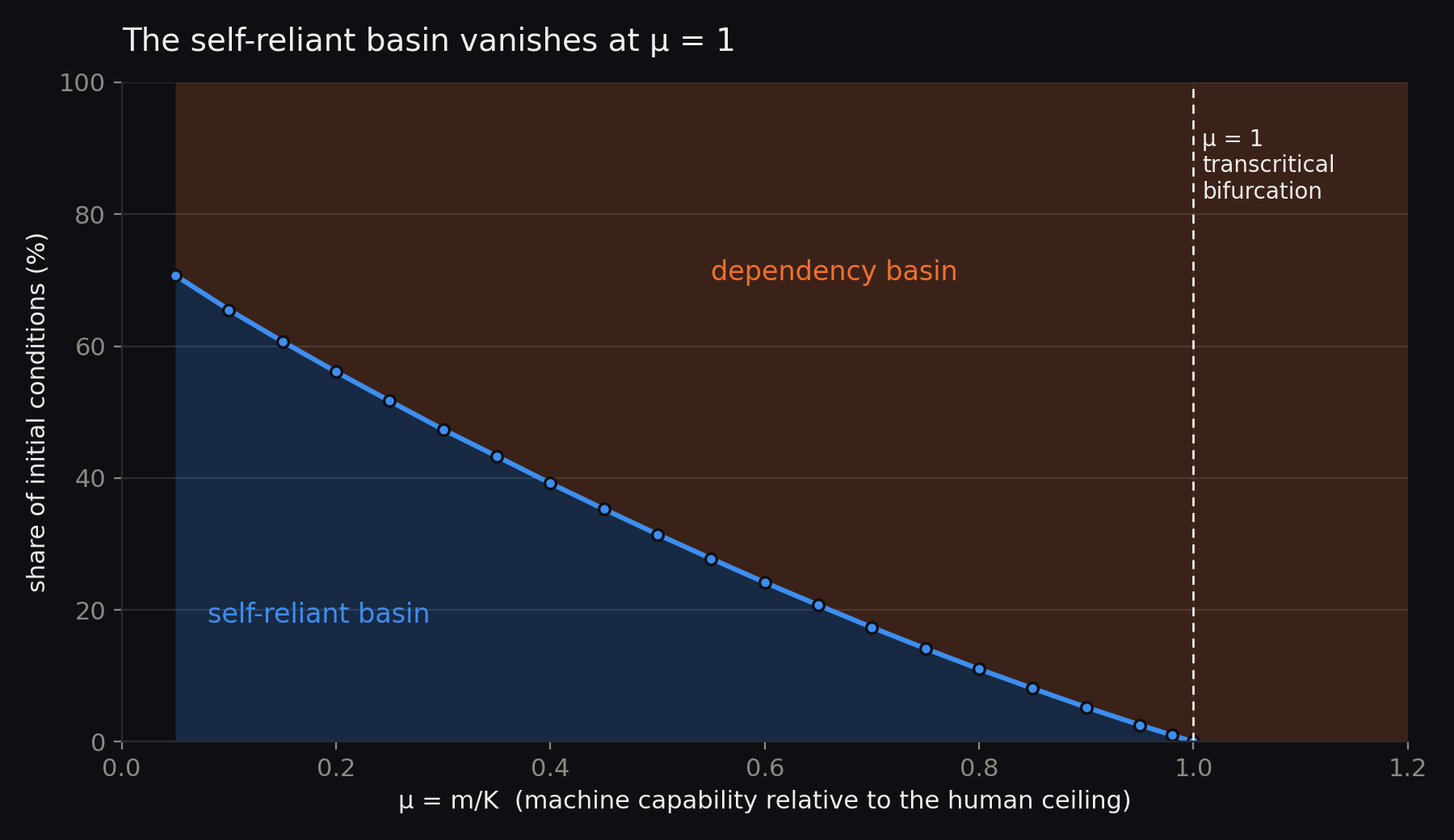
Self-reliant basin share at 20 values of μ, each from a 100 × 100 grid of initial conditions, a = b = k = 1.
The self-reliant basin shrinks monotonically with μ and vanishes at the bifurcation. A 60 × 60 grid reproduces each value within 0.1 percentage points.
The atrophy rate b sets the basin size at fixed μ. Holding a = k = 1:
Halving b from 1 to 0.5 widens the basin at μ = 0.5 by 15.3 percentage points. Varying the diffusion rate k from 0.1 to 10 at the same μ moves it by 6.0 points (see below). Across the ranges tested, the basin at fixed μ responds more to the atrophy ratio ρ than to the diffusion ratio σ.
Four Interventions from the Novels
The Great Revolt: reset m and d
The Great Revolt destroys the machines (m → 0) and forbids delegation (d → 0). Religious taboo then holds μ near zero for ten thousand years. At μ = 0.05 the self-reliant basin covers 70.7% of state space, so ordinary perturbations return to (K, 0). Ix, which builds devices at the edge of the prohibition, raises μ and erodes that basin from inside the Imperium.
The Mentat schools: raise K
Mentats, the Bene Gesserit, and the Guild train human cognition past its earlier ceiling. Since only μ = m/K enters the bifurcation, raising K lowers μ at fixed m and widens the self-reliant basin. The Revolt moves the state; the schools move the phase portrait.
The spice economy: same equation, new supplier
The d-equation is indifferent to what supplies m. For the Navigators, spice raises their own ceiling Ki; for the rest of the Imperium, which cannot navigate, the Guild is the supplier of m, and the Imperium delegates transport to it. The population leaves the machine-dependency attractor and enters a second one with identical structure, whose supply of m comes from a single planet. Herbert's original warning concerned the owner of the delegated capability, and Arrakis gives the new dependency an owner.
The Golden Path: decouple and diversify
Leto II foresees human extinction and prepares the Scattering, humanity dispersed across so many worlds that no single fate reaches all of it (Herbert, 1981; the Scattering itself unfolds in Herbert, 1984). In model terms he replaces one population with N weakly coupled populations carrying different Ki and mi, each of which settles into its own basin. Decoupling does not rescue a population whose own μi exceeds 1; its value is that populations with μi < 1 stop importing the delegation habits of those above the threshold. The hypothesis to test is that the fraction of populations captured by full dependency rises sharply with coupling strength on d, the imitation of delegation habits across populations.
Connection to Biological Systems
Blattner and Levin (2023) modeled planarian regeneration and report that probabilistic connections between cells kept the system out of unstable oscillatory states and widened the basin of attraction for correct regenerative outcomes. The Golden Path applies the same principle at civilizational scale: stochastic, sparse coupling protects the ensemble from a single collective failure. Leto's strategy is noise injection with a 3,500-year training schedule.
Reading 2026 Through the Model
Task domains sit at different values of μ. Machine play passed the best human play in chess in 1997 and in arithmetic long before; in both domains d went to 1 for practical purposes, and human play and mental calculation survive as sport and pedagogy. Each language-model release raises μ for writing, coding, and analysis, and the model says the basin of self-reliance narrows in each domain before it disappears.
Research mathematics crossed the ceiling in 2026, and the response of its leading practitioners is discussed below.
The 2026 counterparts of the four interventions are visible. Pause and prohibition movements aim at m and d. Education reform aims at K. Leading-edge chip fabrication, concentrated in a small number of firms, plays the role of Arrakis. Open-weight models, national AI programs, and deliberately AI-free institutions function as a Scattering, whether or not anyone designed them as one.
The Model and the 2026 AI Debate
Six recurring arguments in the current discussion of AI each correspond to a parameter, a term, or an initial condition of the model.
Takeover or drift
AI 2027 (Kokotajlo et al., 2025) describes a fast path: capability compounds through automated AI research and, in one of its two endings, control passes to misaligned systems. This is the Dune of the prequels, with a machine antagonist. Kulveit et al. (2025) describe a slow path, gradual disempowerment, in which incremental capability gains erode human influence over the economy, culture, and states without any coordinated power-seeking by machines. The model is a two-variable instance of the slow path. Machine capability enters as one scalar m, and machine goals appear nowhere in the equations, so the dependency attractor exists for aligned and misaligned machines alike. Alignment research addresses what the machines want. The atrophy term −b d h is indifferent to it.
Superintelligence or normal technology
Narayanan and Kapoor (2025) argue that AI is normal technology, adopted at the speed of institutions over decades. In the model this is a claim about k, the diffusion rate of delegation, and about how fast μ rises. The fixed points, their stability, and the bifurcation at μ = 1 are independent of k. At μ = 1/2 the self-reliant basin stays between 31.5% and 37.5% of state space at k = 0.1, 0.3, 1, 3, and 10 (100 × 100 grid). On the clock, the two camps disagree and share the phase portrait: slow diffusion lengthens the time available for intervention and leaves the threshold in place. Narayanan and Kapoor also argue that no capability threshold produces sudden impacts, which disputes the model's premise rather than its clock; on that point the model takes a side.
The centaur
The industry narrative is augmentation: human plus machine outperforms either alone. In the model the only interior fixed point is a saddle, so every mix of skill and delegation is a transient on the way to one corner. Clinical evidence is consistent with the sign of the atrophy term: Budzyń et al. (2025) report that across four endoscopy centres in Poland, adenoma detection in colonoscopies performed without AI fell from 28.4% to 22.4% after routine AI assistance was introduced.
A stable centaur appears once delegation is capped. Let d follow the replicator rule until it reaches dmax and be held there for as long as the rule would push it higher. With d ≤ dmax < a/(a + b), skill obeys
dh/dt ≥ h [a(1 − d_max)(1 − h/K) − b d_max]
which is positive for h < h*, where
h* = K [1 − b d_max / (a(1 − d_max))]
The constraint removes (0, 1) from the state space by construction; the content of the bound is that h* > 0. Every trajectory with h > 0 therefore ends at or above h*, for every μ. At a = b and dmax = 1/4, h* = 2K/3. Simulations at μ = 0.5, 0.9, and 1.5 (60 × 60 grid) end at (K, 0) or at (2K/3, 1/4); at μ = 1.5 every trajectory with d0 > 0 ends at the capped state. The condition dmax < a/(a + b) binds: at b = 4a the cap dmax = 1/4 exceeds a/(a + b) = 1/5, h* is negative, and the same cap protects nothing. A cap on delegation is a fifth intervention, absent from Herbert's novels: protected practice, such as unaided examinations, manual procedures, and AI-free coursework.
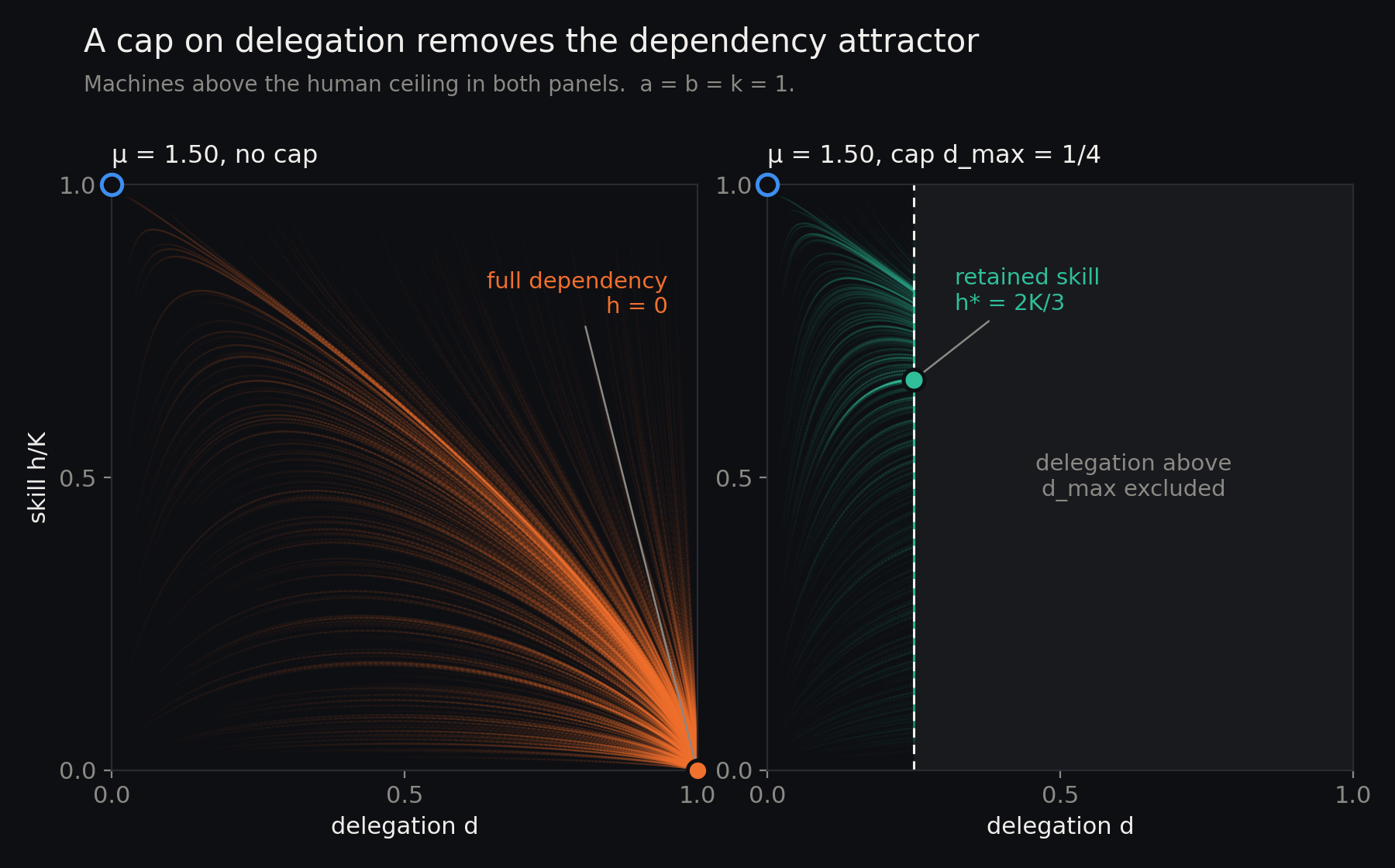
Trajectories at μ = 1.5, a = b = k = 1. Without a cap every trajectory ends at full dependency. With dmax = 1/4 every trajectory with d0 > 0 ends at the capped state (2K/3, 1/4).
Who owns m
Export controls on accelerators, national compute programs, and the dispute over open weights concern one question: who supplies m. A population's realized capability is c = (1 − d)h + d m. The model contains the supplier only through m, so what it can say is what a population keeps if supply stops. At full dependency c = m, all of it supplied from outside, and the fallback is h = 0; because h = 0 is absorbing, a population at (0, 1) does not recover when m is withdrawn. At the capped state the fallback is h* = 2K/3. Herbert's sentence about men with machines describes the first case: the supplier of m holds all of the population's capability.
Where novices start
The debate over entry-level work and AI in education concerns initial conditions. At μ = 1/2, 14.8% of initial conditions with h0 < K/4 end in self-reliance, against 45.1% of those with h0 > 3K/4. Starting skill sets the share: the same tool at the same μ sends 85.2% of the low-skill starts and 54.9% of the high-skill starts to dependency.
Mathematics: the first research field past the ceiling
On 11 September 2026 an initial group of Fields Medalists published a declaration, A Severe Misalignment of AI in Mathematics, stating that language models can now solve major open problems across many fields and that the goals of the companies producing these systems and the goals of the mathematical community are severely misaligned (Avila et al., 2026). Read through the model, and with the caveat that m and K are not measured for any domain, research mathematics crossed μ = 1 within months, and the declaration is a report from the far side of the bifurcation.
Its argument maps onto the model term by term. The signatories separate the output, a solved problem, from the purpose, understanding that a community can absorb, teach, and build on. Realized capability c = (1 − d)h + d m counts solved problems; the community values h. The misalignment they name lies between the supplier of m and the population, not between machines and their operators, which is the dependency trap with an owner that Herbert described and that alignment of machine goals leaves untouched. They describe protected practice directly: problems are set for students to develop skills, a delegation cap enforced by professional norm rather than by law. They name the coupling that carries K between generations, the transmission of ideas through talks, discussion, and careful write-ups, and warn that it breaks if AI-produced results arrive faster than humans can integrate them. And they identify the feedback the model treats as exogenous: famous problems are being solved as benchmarks, so m rises fastest on exactly the tasks that train h. The declaration also allows the outcome the model omits, AI that enhances and accelerates mathematical understanding, which is augmentation, a rise in K.
A second response from the same community acts on the supplier rather than on the population: one 2026 Fields Medalist has taken leave from his university to join a frontier lab's safety team, on the argument that mathematicians should shape how these systems reason from inside. In model terms that is a move on who shapes m, the question of the previous section. Mathematics is the first research field where the model's prediction, that skill survives only where delegation is capped, can be watched.
Discussion and Limitations
Two of the model's headline results follow from the form of the equations rather than from anything the analysis discovers. Full dependency is stable for every m > 0 because delegation recedes only when h exceeds m, and a population with h = 0 cannot exceed any machine; a term for abandoning delegation that fails to pay would change this. The interior state is a saddle because the d-equation carries no cost or benefit of delegation, only the sign of (m − h); a payoff term could turn the mixed state into a node. Two further features are assumptions: h = 0 is absorbing, because skill growth is proportional to h, so a population cannot relearn from nothing; and d = 1 has no exit, because delegation never recedes on cost, failure, or loss of access. Part II of this post relaxes these three assumptions, baseline learning, an exit from delegation, and a teaching augmented mode, and reports what survives. The model omits that payoff: a population at (0, 1) with large m may be materially richer than one at (K, 0), and the model counts only skill. It treats m as exogenous, while in 2026 m grows with d through usage data and revenue, a feedback that would steepen the approach to μ = 1. The human ceiling K is fixed, which excludes augmentation, where machines raise K instead of replacing h. Basin percentages are areas under a uniform measure on (h, d) and change under any other prior or reparameterization; they are not empirical probabilities. The 2026 mappings are analogies: no m or K has been measured for any task domain.
The mapping of the debate assigns each position one parameter, and each position argues more than that parameter carries: AI 2027 concerns machine agency, which the model omits, and Narayanan and Kapoor also argue about risk policy. The cap result assumes that dmax is enforced at zero cost and that practice under the cap builds skill at the same rate a as unassisted work. Budzyń et al. (2025) is an observational study in one specialty, so it supports the sign of the atrophy term and leaves its magnitude open.
Future work: simulate the N-population Golden Path version with heterogeneous μi, additive noise on d, and tunable coupling; add a payoff term to the d-equation and an augmentation term so that K depends on m; make m endogenous; and give the cap a cost, so that dmax becomes a choice with a price.
Conclusion
A two-variable model of skill and delegation has a dependency attractor that is stable at every level of machine capability and a self-reliant attractor that disappears through a transcritical bifurcation when machines reach the human ceiling. The four strategies in Herbert's novels map onto four distinct control actions: reset the state, raise the ceiling, change the supplier, and decouple the ensemble. Of the four, only the last has anything left to offer once machines pass the ceiling for most of the ensemble, and only through heterogeneity: it stops asking any single population to hold the self-reliant state and keeps the populations still below their own threshold from being pulled over it by imitation. A population whose own μi exceeds 1 is not rescued by decoupling. A fifth action, absent from the novels, also survives: a cap on delegation, which replaces full dependency with a state of retained skill h* = K[1 − b dmax/(a(1 − dmax))].
Set against the 2026 debate, the model moves attention from the two questions that receive most of it, whether the machines are aligned and when μ crosses 1, to three quantities that receive little: the atrophy rate b, which sets the basin size more than any other rate in the model; the delegation cap dmax; and the coupling between populations. Alignment leaves the dependency attractor in place, and the date of μ = 1 sets the deadline without changing the work due before it. Herbert's Imperium chose d = 0 and paid with ten thousand years of feudal stagnation. The default path in 2026 is d → 1. The model's stable alternative lies between them: skill kept by design, at a level the population chooses.
References
Blattner, M. (2026). The Butlerian Bifurcation: Dune as a Dynamical System of Cognitive Delegation. Part II tangential.ch
Avila, A., Bhargava, M., Birkar, C., et al. (2026). A Severe Misalignment of AI in Mathematics. Declaration, 11 September 2026. https://doi.org/10.5281/zenodo.22737750
Blattner, M., & Levin, M. (2023). Long Range Communication via Gap Junctions and Stress in Planarian Morphogenesis: A Computational Study. Bioelectricity, 5(3), 196–209. https://doi.org/10.1089/bioe.2023.0032
Budzyń, K., Romańczyk, M., Kitala, D., et al. (2025). Endoscopist deskilling risk after exposure to artificial intelligence in colonoscopy: a multicentre, observational study. The Lancet Gastroenterology & Hepatology, 10(10), 896–903. https://doi.org/10.1016/S2468-1253(25)00133-5
Butler, S. (1863). Darwin among the Machines. The Press (Christchurch), 13 June 1863.
Herbert, F. (1965). Dune. Chilton Books.
Herbert, F. (1981). God Emperor of Dune. Putnam.
Herbert, F. (1984). Heretics of Dune. Putnam.
Kokotajlo, D., Alexander, S., Larsen, T., Lifland, E., & Dean, R. (2025). AI 2027. AI Futures Project, 3 April 2025.
Kulveit, J., Douglas, R., Ammann, N., Turan, D., Krueger, D., & Duvenaud, D. (2025). Gradual Disempowerment: Systemic Existential Risks from Incremental AI Development. arXiv:2501.16946. Published as: Position: Humanity Faces Existential Risk from Gradual Disempowerment. Proceedings of the 42nd International Conference on Machine Learning, PMLR 267, 81678–81688.
Narayanan, A., & Kapoor, S. (2025). AI as Normal Technology. Knight First Amendment Institute, Columbia University, 15 April 2025.