
Experiments
In this section, I publish my experiments. Experiment topics include artificial neural networks, dynamical systems, bio-hacking with BCI, robotics, astrophotography, and more. Some of my experiments made it to published research papers, while others wait to be discovered. The Blog section might be for you if you want more digestible content.
How I use Generative AI for my experiments: mainly polishing my writing drafts. and for boilerplate code. Ideas and math are mine; storytelling often by GenAI.
Expect a new entry every second week.
The Butlerian Bifurcation: Dune as a Dynamical System of Cognitive Delegation. Part II
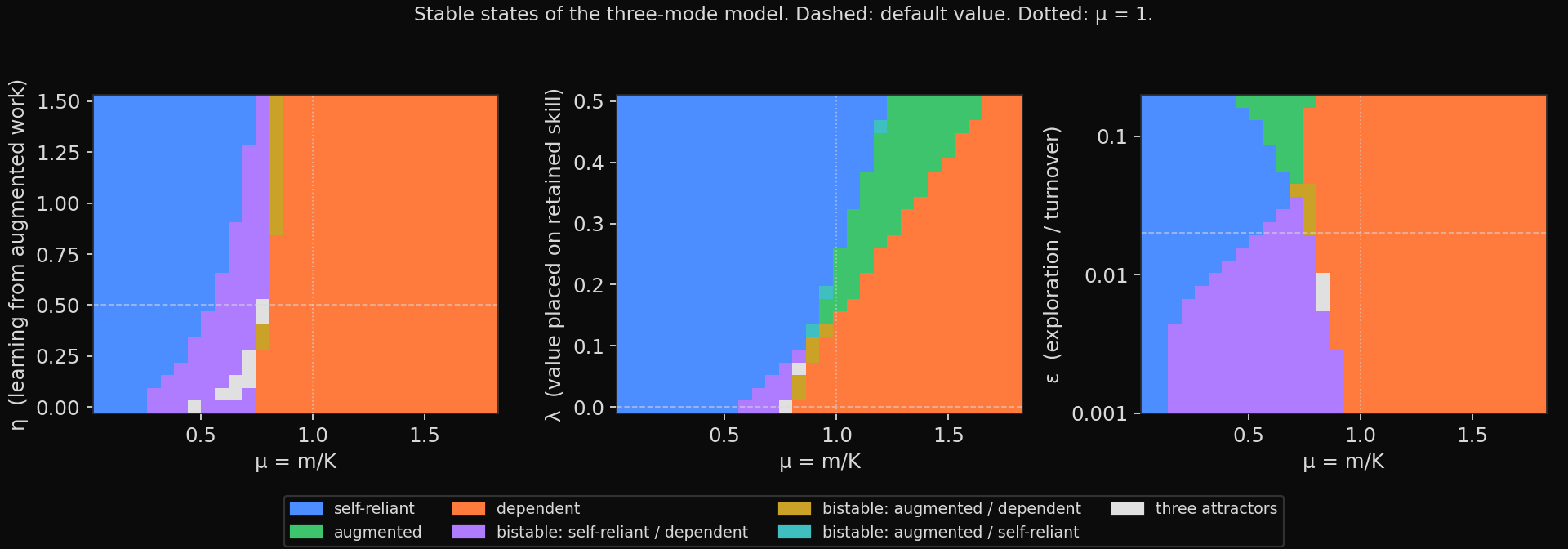
Part I modeled cognitive delegation, humans handing thinking to machines, as a two-variable dynamical system read through Dune, and found a threshold: once machines reach the human ceiling, self-reliance vanishes and dependency is the only stable state. Three assumptions did the work. Part II drops them: populations can relearn, delegation can be abandoned, and AI-assisted work can teach. The threshold survives but splits in two, and the gap between is hysteresis: dependency, once entered, is left only when machines fall well below the level at which it was entered. The width of that gap is set by how fast a population changes its practice. And a stable mixed state, human and machine together, appears only when the population places a value on the skill it keeps.
The Butlerian Bifurcation: Dune as a Dynamical System of Cognitive Delegation. Part I
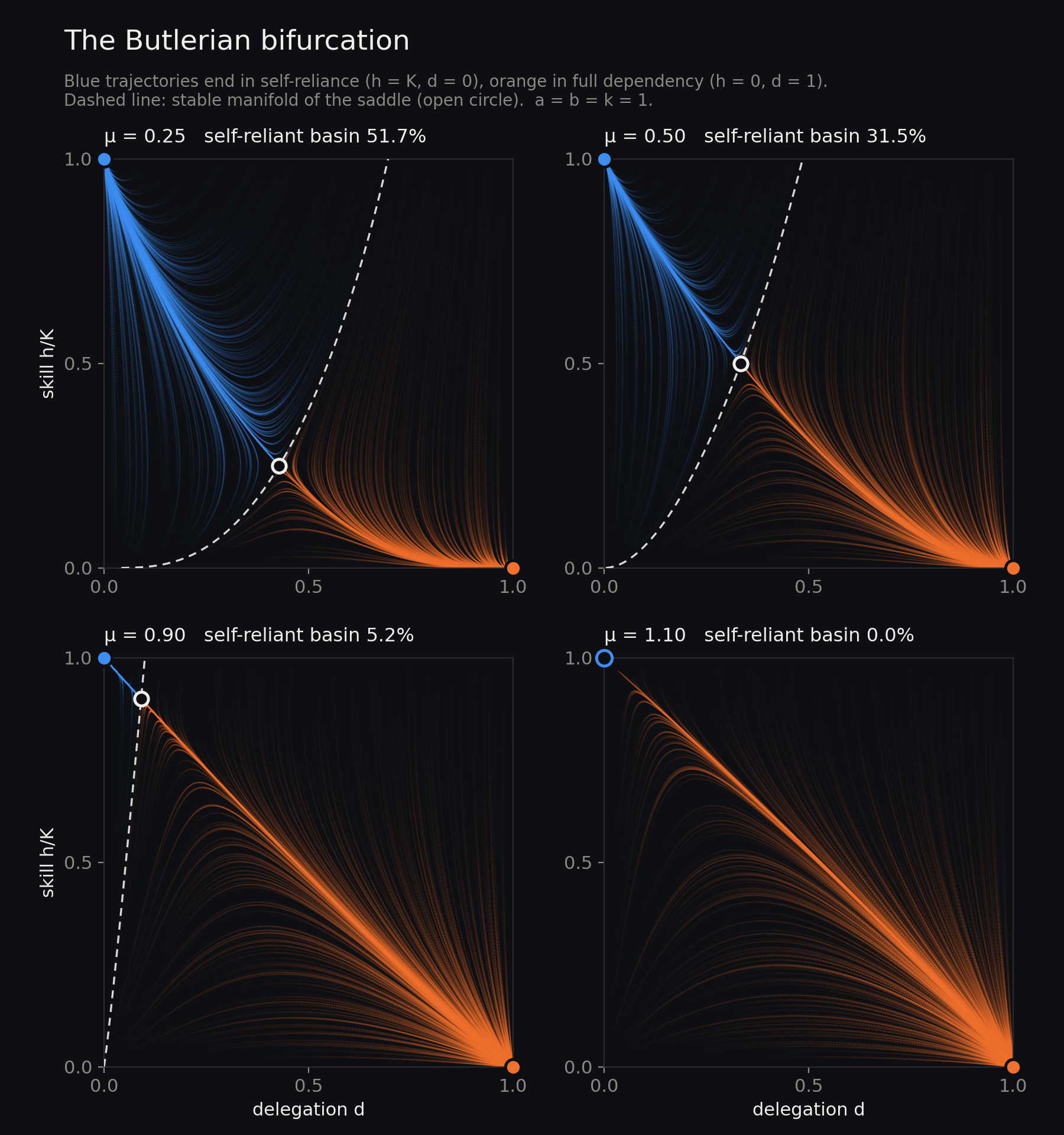
Herbert's Dune universe rests on a ban on thinking machines, justified by a dependency trap rather than a robot uprising. This thought experiment writes that trap as two coupled equations for human skill and delegation to machines. The model has two attractors: full dependency, which is stable at every level of machine capability, and self-reliance, which vanishes through a transcritical bifurcation when machines match the human ceiling. Simulations show the self-reliant basin shrinking from 71% of state space to zero along the way. The four strategies in the novels (the Jihad, the Mentat schools, the spice economy, the Golden Path) map onto four distinct control actions, and five arguments in the 2026 AI debate map onto the model's parameters. A fifth intervention Herbert never wrote, a cap on delegation, keeps skill at a chosen level even after machines surpass humans.

Noise as a Feature: From Biological Morphogenesis to Neural Network Robustness
Noise is often perceived as an unwanted disturbance, a bug to be eliminated from engineered systems. However, mounting evidence from biological systems suggests that noise serves essential functional roles, acting as a feature that enhances robustness, flexibility, and adaptive capabilities.

Adaptive PID Controller
Proportional-Integral-Derivative (PID) controllers are foundational in industrial automation but exhibit limitations when faced with non-linear or time-varying system dynamics due to their fixed gain parameters. This experiment outlines a conceptual framework for an adaptive PID control system.

Enforcing Symbolic Constraints in Graph Transformers via Low-Rank Logic Adapters
This post introduces Symbolic Masked Graph Transformers (SM-GT), an architectural approach designed to integrate hard, type-based exclusion rules directly into the GT attention mechanism, ensuring provable compliance.
