Services ↘︎
Research
Tangential Action Spaces (TAS) is my geometric framework for embodied agents. It represents an agent as a hierarchy of smooth manifolds: physical states, cognitive representations and intentional goals - connected by projection maps from the physical to the cognitive level and onward to intentions. Perception runs up this hierarchy; action runs back down.
That descent is never unique: lifting an intention back into a concrete movement can follow many routes, and the routes differ in what they cost and in whether they leave a trace.
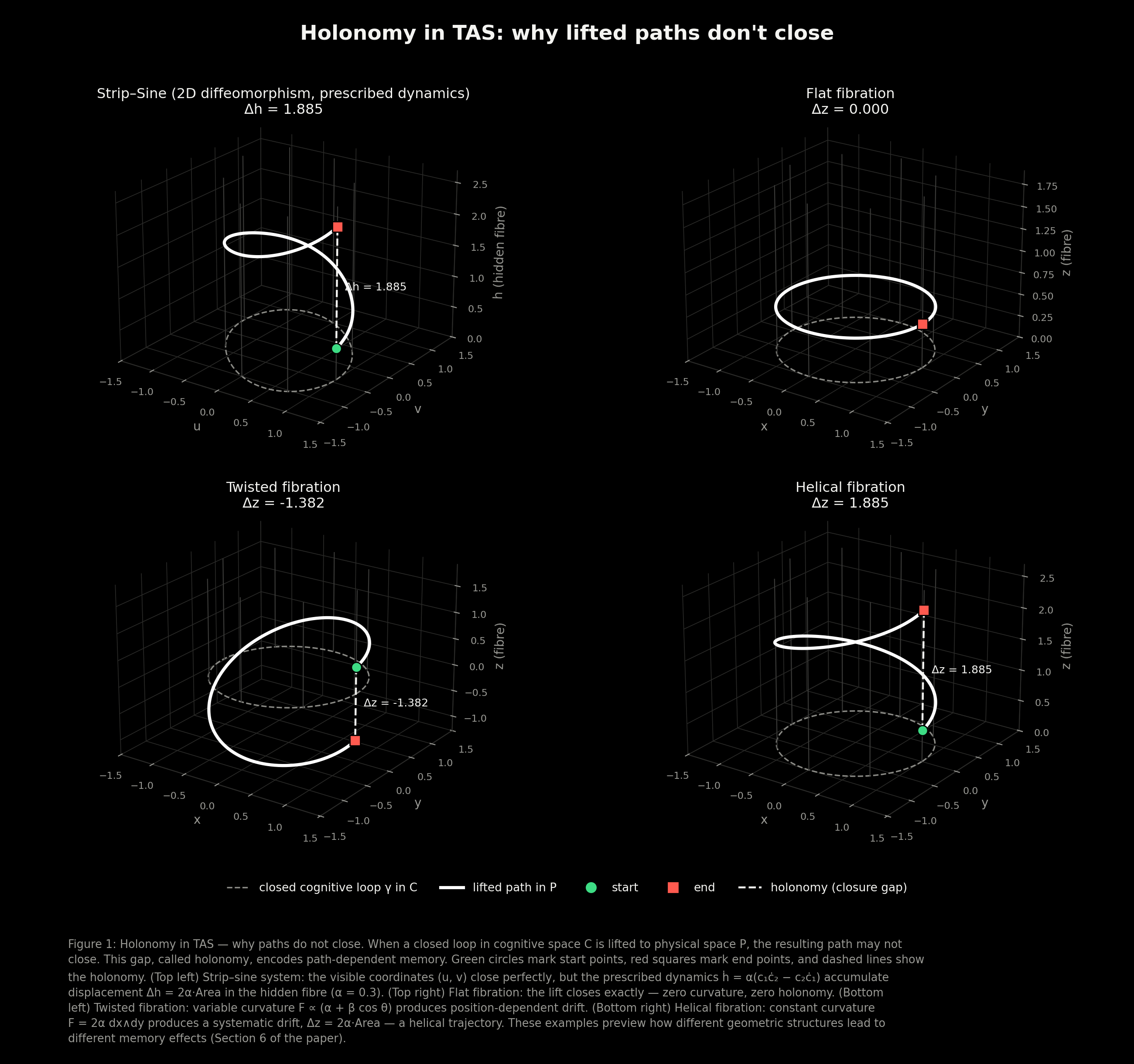
The central result is a cost–memory duality. The energetically cheapest lift is fixed by the physical metric alone, and it forgets: after a closed loop in cognitive space the body returns exactly to where it started. Any lift that leaves path-dependent memory pays a strictly positive energy premium, and for small loops that premium grows with the square of the memory written. Where many physical states share one cognitive state, that memory can arise intrinsically from the curvature of the connection rather than from engineered dynamics. Memory, in this picture, is something an agent has to pay for - and the geometry says how much.
References:
Tangential Action Spaces: Geometry, Memory and Cost in Holonomic and Nonholonomic Agents