
Blog
In this section, I write on topics ranging from Artificial Intelligence to business to astrophotography. If you are seeking more technical depth, feel free to explore the Experiments section.
How I use Generative AI for my blog: mainly polishing my writing drafts. and for boilerplate code. Ideas and math are mine; storytelling often by GenAI.
Expect a new entry every second week.

The Equation and the Problem: What OpenAI's Navier-Stokes Result Addresses
OpenAI's announcement of September 8, 2026 was widely summarized as a solution of the Navier-Stokes equations. The result is a Lean-formalized construction that addresses the forced breakdown formulation of the Navier-Stokes existence and smoothness problem. This post separates the equations from the problem, the problem from its formal statement, and the formal statement from its machine-checked encoding.

The Machine That Checks: What Lean Is, How It Works, and What It Finds in a Tangential Action Space
Lean is a programming language whose proofs are checked by a kernel of a few thousand lines, which makes the origin of a proof irrelevant to its acceptance. This post covers why that architecture matters, how propositions-as-types produces it, and what happened when the cost-memory law from the Tangential Action Spaces paper was restated as a machine-checked theorem. The formalization surfaced a degenerate case the informal argument absorbs, and located the boundary of Lean's automation somewhere other than where intuition puts it.

Other Planets of Intelligence: What AI in Mathematics Indicates for Other Fields
Klowden and Tao treat mathematics as a sandbox for AI: a field where results can be verified objectively. This post extends their argument. Mathematics has the strongest verification machinery of any discipline, so the problems documented there, outputs without understanding, misfiring professional judgment, broken training paths, indicate what every other field can expect with weaker protections.
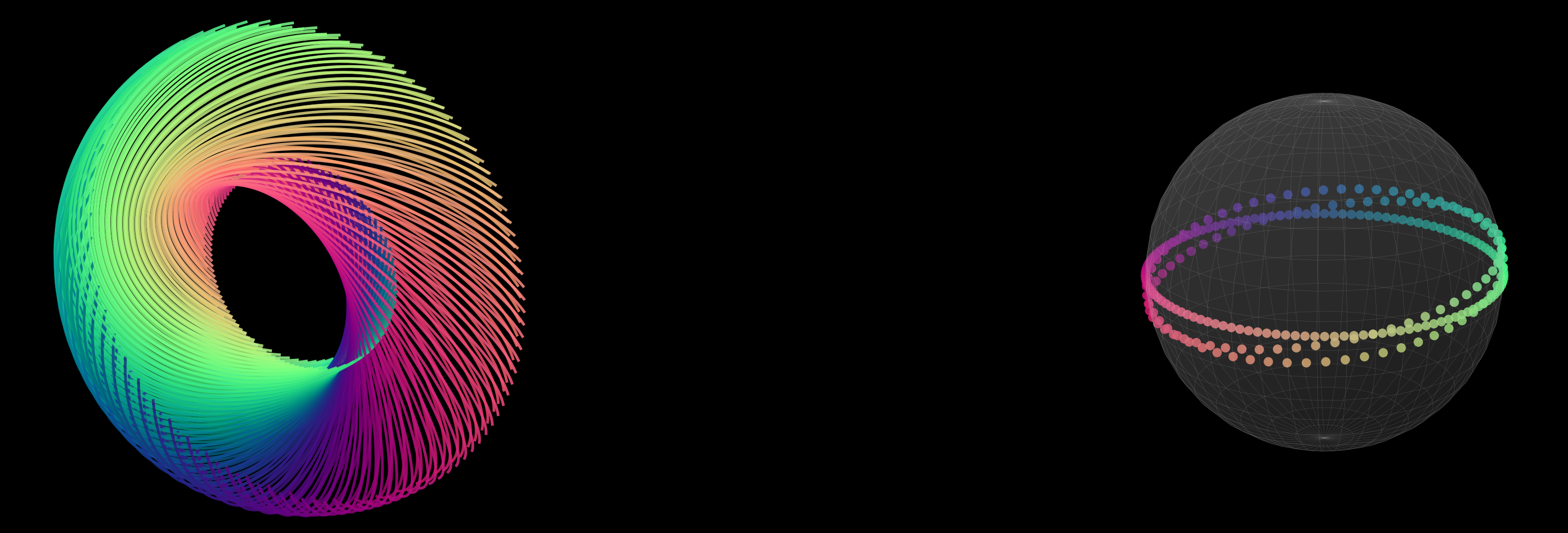
The Geometry of Memory: How Actions Leave Traces in Your Body
Tangential Action Spaces (TAS) provide a geometric framework for embodied agency, modeling agents as a hierarchy of abstract physical, cognitive, and intentional spaces . This model reveals a fundamental trade-off between an agent's energetic efficiency and its capacity for experiential memory. The central finding is a "cost-memory duality," which states that path-dependent memory is never free and incurs a quantifiable excess energy cost. This predictive framework unifies cost, memory, and learning, providing a new language to analyze agent behavior, self-modification, and social dynamics.

Learning Machine Learning Through Interactive Exploration
The field of machine learning evolves at a relentless pace. New architectures emerge monthly, terminology shifts quarterly, and what seemed cutting-edge last year becomes foundational knowledge today. This creates a unique challenge: how do we build educational resources that remain both accessible to beginners and relevant to practitioners?

Automate the Automation
The average knowledge worker switches between applications 10 times per hour and spends 4-8 hours weekly on repetitive tasks. These patterns, forwarding emails, scheduling follow-ups, and updating documentation, are predictable yet remain manual. Workflow Whisperer addresses this inefficiency through an agent-based architecture that learns from observation rather than configuration.

Evolutionary Algorithms: A Gentle Introduction to Problem Solving, Inspired by Nature
Evolutionary Algorithms (EAs) represent a fascinating branch of artificial intelligence and computer science, drawing their core inspiration from the processes of biological evolution to tackle complex problems. Rather than depending on precisely defined instructions to reach a solution, EAs employ a simulated version of "survival of the fittest."

The Hidden (R)Evolution
This blog post is about my small booklet "The Hidden (R)Evolution". I document how scientists are moving beyond traditional machines made of metal and silicon and instead using living materials to create new kinds of systems. The idea to write about this topic emerged during my collaboration with Dr. Michael Levin, a Professor at Tufts University. Michael is a developmental biologist.